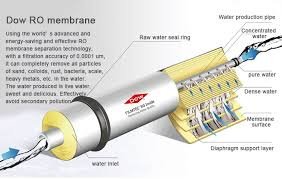
How the RO Membrane Works
The membrane is a semi-permeable sheet with tiny pores (about 0.0001 microns). When water is forced through it under pressure, it allows only pure water molecules to pass through, while rejecting:
-
Dissolved salts (TDS)
-
Heavy metals (like lead, arsenic, mercury)
-
Fluoride, nitrates, sulfates
-
Microorganisms (bacteria, viruses, cysts)
-
Hardness-causing ions (calcium, magnesium)
💧 What It Removes (Effectively)
| Substance | Removed by RO Membrane? | Notes |
|---|---|---|
| TDS (Total Dissolved Solids) | ✅ Yes | Key purpose of RO |
| Bacteria/Viruses | ✅ Yes | Better if paired with UV |
| Heavy metals (e.g., arsenic, lead) | ✅ Yes | Very effective |
| Pesticides/chemicals | ✅ Yes | Depending on size |
| Essential minerals | ❌ Removed too | Hence the need for mineralizer filters |
| Chlorine/odors | ❌ No | Removed by pre-carbon filter instead |
💡 Key Features
-
Pore size: ~0.0001 micron
-
Pressure required: 40–100 psi (a booster pump is often needed)
-
Life span: ~1–2 years depending on water quality and usage
-
Material: Usually made of thin-film composite (TFC) polyamide
🧪 RO Membrane vs Other Filters
| Filter Type | Removes TDS? | Removes Microbes? | Removes Chlorine/Odor? |
|---|---|---|---|
| RO Membrane | ✅ Yes | ✅ Yes | ❌ No |
| UV Filter | ❌ No | ✅ Yes (kills only) | ❌ No |
| UF Filter | ❌ No | ✅ Some | ❌ No |
| Carbon Filter | ❌ No | ❌ No | ✅ Yes |
🛠️ Maintenance Tip
You must replace the RO membrane periodically (typically every 1–2 years), especially if:
-
TDS levels in output water start rising
-
Water flow slows significantly
-
Bad taste or smell develops